Aldous Harding — Salle Pleyel
Chronique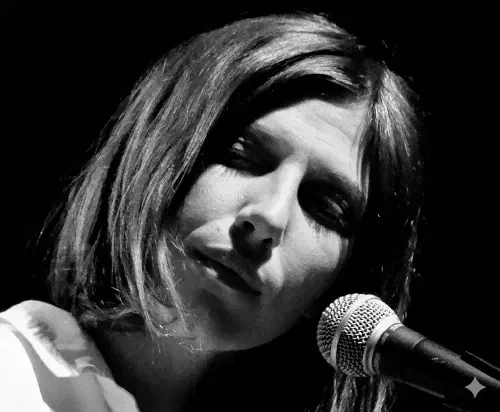
Salle Pleyel — 12 June 2026
Until then, for me, Aldous Harding was a niche. Strictly no one in my circle had ever heard of her. Except the members of my family, who had little taste for the depressive singer. I had seen her live twice. First, in March 2016, I’d dragged my daughter to Laval for a set in a small, half-empty room. In December of the same year I made the trip to Nantes alone, for La Folk Journée, a micro folk festival, the counterpart to La Folle Journée, that Nantes institution. She carried the whole concert with just her guitar and a keyboard. No need for more — she already had her voice, her voices. She had evidently made the journey from New Zealand alone.
The hall isn’t full, but I booked any old how. I’m a long way from the stage. A pity. Opening the evening, Vera Ellen, a New Zealander too. Interesting, but I’m finding it hard to focus — I’ve really come for Aldous Harding. Pleyel, true to its tradition as a classical-music hall, announces the interval, its duration, the presence of a bar. At a pop, rock or folk gig, no need to spell it out: everyone knows it takes time to move from one act to the next. A small touch of anachronism.
In front of me, a (very) young woman. She spent the interval taking selfies and sending them on some social network I didn’t recognise. Then her neighbours settled in and the man went off for a beer. The woman struck up a conversation. Instantly, emotion overwhelms the young woman; she wipes away a few tears. I’m curious; I try to make out what they’re saying, in English. I gather that the young woman is a New Zealander, an au pair with a wealthy family in the 16th arrondissement. I put the tears down to homesickness.
Aldous Harding comes on stage after her musicians. Well — she’s cut her hair.
I’m surprised, right from the start of the show: I know and recognise every song. That’s unusual — I’m so used to seeing, on stage, only bands I barely know. My neighbour wipes away a few tears during the first songs. I’m moved too — less than her, no doubt.
Aldous Harding is just as I remembered her. A strangeness emanates from her. First, this indifference to silence. She fears neither the lulls nor the quiet. There’s always a long moment between songs. Everything has to be ready for the next one, and everyone ready too. The hall is reassured. No whistling, no impatient shouts. A mishap: Aldous forgets to fit the capo on the neck of her guitar. She tunes up, realises she’s forgotten it, retrieves the thing from the floor, apologises, fits it on the neck, tunes again, apologises once more. Pointless apologies — this is the tempo of the performance. No one is in a hurry, there’s no urgency. The time of silence is part of the show. Sure enough, a “How are you?” rings out; she answers “Fine, I’m on stage”. An “I love you” is thrown out. I didn’t quite catch the reply, which ends with “… you see I’m here”. Perhaps to say that, since she was in the middle of a concert, it wasn’t really the best moment.
The songs follow one another. Mali Llywelyn is on piano. Then she takes up the harp, and finally Aldous hands over her guitar. She also supports the singing on certain choruses. At every change of register the hall noisily voices its delight. The “boys” at the back of the stage, in the half-light, are discretion itself.
Aldous Harding — or perhaps I should call her here Hannah Topp, the name under which she signs her work. Let’s keep Aldous; it’s complicated enough as it is. Aldous, then, distils her plurality, which is what makes her fascinating to me, across almost the whole setlist. For “Leathery Whip” she takes on her little-girl voice, triggering a sudden burst of feedback. Even the equipment is caught off guard. Another song: having finished singing, she lay down; the band kept playing, finished the piece. Aldous is still lying there. Will she get up? It goes on, a long time. Of course she’s going to get up, yet doubt creeps over me all the same. It isn’t reasoned, more instinctive. I think it’s the moment when the roadie relieves Mali of her harp. And then there’s “Imagining My Man”. That break, and Mali crying out Yeah. I wait for it; it comes. In the next verse, so like the one before, there’s the break but no Yeah. And the song goes on like that. An alternation of bliss and frustration.
She was seated at the start of the concert; she only plays the guitar sitting down. Once on her feet and rid of a jacket, plainly unsuited to the temperature, she’s wearing a T-shirt, perhaps a shirt, with long ribbons hanging from it. A good fifty centimetres each. They echo her movements, her arms in particular — themselves floating ribbons, badly mastered. She reminds me of those teenagers, boys and girls alike, ill at ease in a body that has grown too fast, one they don’t yet perceive as it really is.
Far too many people at the merch stand at the end of the show. A shame, because of course I’d happily have bought a T-shirt — and on top of that, I’ve got nothing to wear tomorrow.